
This page documents a previous-generation product, retained for reference. For current products see QTFM Gen‑2.
Overview
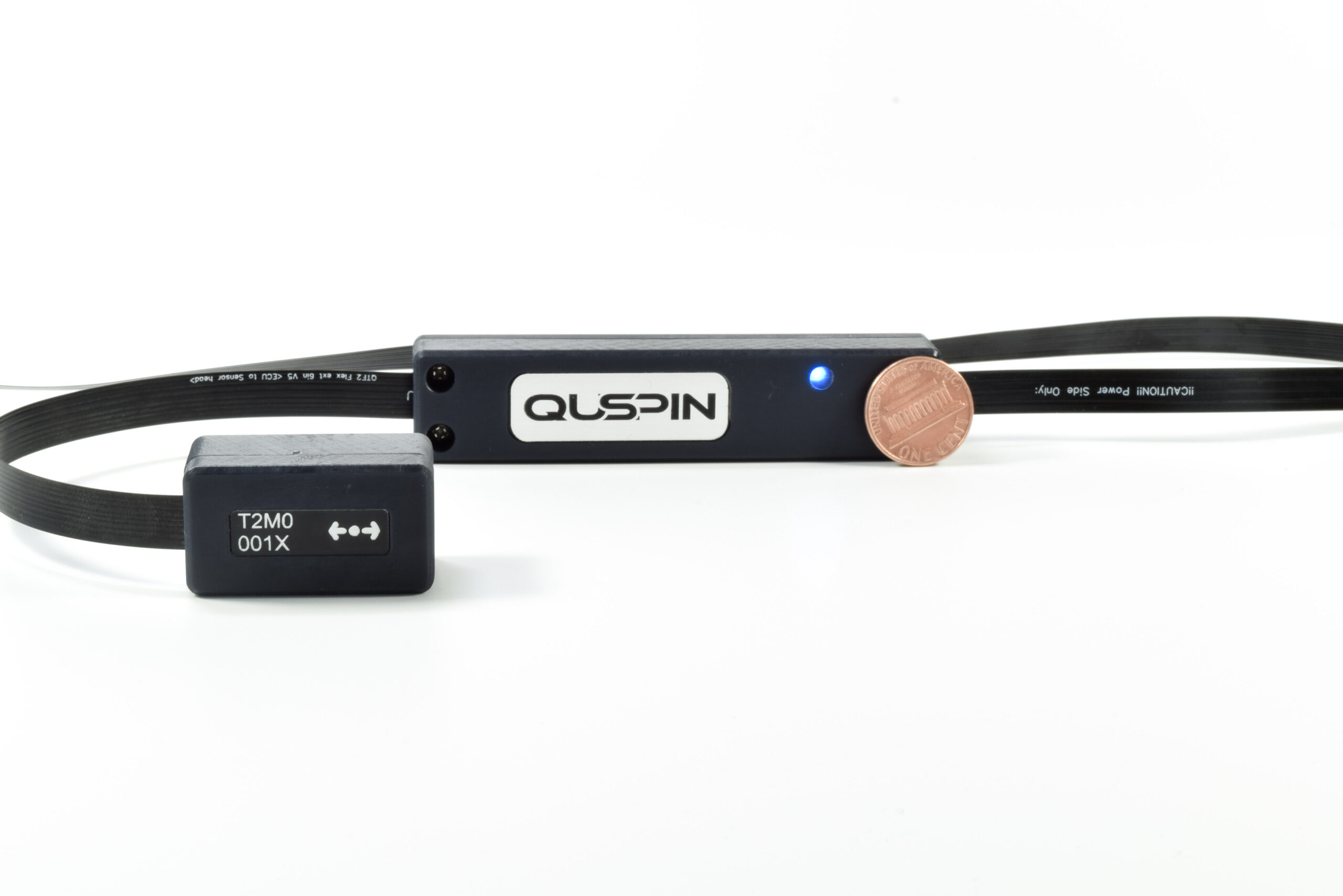
The QuSpin Total‑Field Magnetometer (QTFM) is a compact, high-sensitivity hybrid scalar + three-axis vector atomic magnetometer for geophysical applications. It is extremely accurate, stable, and can resolve minute field changes. A compact, low-power package makes it ideal for use in a wide range of applications from magnetic observatories to small, mobile platforms such as UAVs.
Technical Specifications (Preliminary)
| Sensitivity Resolution in a 1 s measurement interval | Scalar: <5 pT/√Hz (typ. 3 pT/√Hz); Vector: <0.1 nT/√Hz (optional add-on) |
| Data Rate | 1000 samples/sec (maximum) |
| Bandwidth | 500 Hz |
| Deadzone | Axial only, < ± 7º cone about earth’s field (typical < 5º) (diagram ) |
| Heading Error Deviation from ideal behavior in which the output changes slightly based on how the sensor is oriented with respect to the background field | <3 nT uncompensated |
| Dynamic Range | 1000 nT to 150,000 nT |
| Operating Temperature | −15 °C to 55 °C |
| Size | 17.7 × 19.8 × 35.8 mm (sensor head), 14.7 × 24.4 × 92.3 mm (ECU housing) |
| Weight | 12 grams for sensor head + 29 grams for electronics/ECU (ECU without housing is 6.5 g) |
| Power | +5 V input (using SCB) or 10–12 V input (sensor powered directly), 2.5 W total, 3.5 W during startup |
| Slew Rate Limit | None |
| Outputs | UART (RS232), USB |
| Max Gradient Field Maximum gradient field sensor can tolerate before sensitivity starts to degrade | 300 nT/cm |
| Calibration | None |
| Type | Pulsed laser-pumped rubidium, free induction decay (link ) |
Features
- Optional add-on: Integrated, stable, low-noise three-axis vector outputs (synthetic1)
- Flat spectral response (no frequency-dependent response roll-off)
- Built-in customizable digital filters (low-pass, high-pass, notch)
- Multiple sensors can be precisely synchronized for gradiometry
- Negligible dead zones
- No slew rate limitations (can tolerate extremely magnetically noisy environments)
- Built-in high-resolution frequency counter
1Vector outputs are synthetically derived (calculated) from scalar measurements by applying bias fields in interleaved measurement cycles (link)
Pricing
| Quantity | Price per sensor |
|---|---|
| Qty 1–3 | $10,000 |
| Qty 4–7 | $8,500 |
| Qty 8+ | $8,000 |
| Vector add-on | +$1,500 |
Please call for pricing for larger volumes or potential OEM applications.
Documentation & Accessories
- User Guide
- 3D CAD files
- Brochure
Accessories
- Standard Comms Board ( included with QTFM; for USB connectivity and power regulation )
- Triaxial Vector Coil Upgrade ( optional add-on; converts QTFM from scalar to hybrid scalar + three-axis vector magnetometer )
- Advanced Comms board ( optional add-on; for wireless Bluetooth connectivity, GPS integration, and saving data to an onboard SD card )
- Carbon Fiber Housing ( optional add-on; compact and robust external packaging ) [Retiring soon]
- Magpie ( fully integrated, ready to deploy magnetic survey platform with onboard GPS, IMU, data logging, and wireless connectivity )
- Battery pack ( coming soon )
- Ethernet-based cable extension ( coming soon )
Technical Support
Export Restrictions
QTFM is export controlled by the US Department of Commerce (ECCN: 6A006.a.2). QTFM can be shipped to most European countries, Japan, Australia, and South Korea without a license. Some key countries such as China, India, Russia are excluded and a license from the DOC is required before QTFM can be shipped to these countries. A license approval can take over 8–12 weeks and requires detailed information on the end-user and end-use application.
A low-performance variant of the QTFM sensor (QTFM‑B) with sensitivity worse than 20 pT/√Hz (ECCN: 6A996.a) is now available which can be shipped to nearly all countries without a license. The only operational difference between QTFM and QTFM‑B is sensitivity.